Help & support
A money mule is a person or business that receives or transfers money on behalf of someone else to help disguise it from being associated with illegal activity. This is usually done through a bank account or with cash. Money mules are often paid a fee or commission.
As part of Australian anti-money laundering and counter terrorism financing laws, money muling is considered criminal activity. Even if you’re unaware, you could still be held legally responsible.
Sam received a message on WhatsApp from an unknown number offering an easy full time/part time job.
The benefits listed were:
Requirements for the role were:
Ari got an email saying she was owed a refund from an online store she’d used before. The message looked real and said they had overcharged her. Soon after, money appeared in her bank account.
The sender then contacted her again, claiming the refund was a mistake and asking her to send some of the money back to a different account. They said it was routine and even told her she could keep a small amount for the trouble.
Trusting this, Ari sent the money. Later, she found out the payment was part of a scam, and her account had been used to move stolen funds.
Ming was contacted by scammers, pretending to be the Chinese police force. The ‘Chinese police’ told Ming his visa and passport had been used in criminal activity overseas and that he needed to pay bail pending a trial in China.
The ‘Chinese police’ harassed Ming every hour so that they could monitor Ming’s whereabouts and told him if he did not listen, he would be facing criminal charges and arrest.
The ‘Chinese police’ demanded Ming transfer his own funds and some received funds to another account in order to release him of criminal charges.
Any legitimate organisation (whether in Australia or overseas) can be impersonated by scammers to intimidate and harass you to transfer funds.
Luka received a friend request from an attractive woman from overseas who he’d never met. After messaging back and forth for a few days, the woman asked Luka to move to a different app so that they could share photos and messages easily and more privately.
Luka then received illicit sexual images from the woman and was pressured into sending some back with the promise that she’d delete any images Luka shared with her.
The woman then used the photos Luka had shared as blackmail to get him to comply with her demands. She asked him to receive money from her associates and then transfer the payments on to other bank accounts she provided.
Emily met someone on a dating app who said they were a professional working overseas. Over time, they built a close connection and messaged each other every day.
After gaining her trust, the person said they were having money problems due to work delays and asked for her help. They told Emily that money would be sent to her account and asked her to transfer it to other accounts to help with “business needs.”
Because of the emotional connection, Emily believed she was helping someone she cared about. Later, she discovered the money was linked to a scam, and her account had been used to move stolen funds.
Sarah owns a small business and received an email from a company claiming to be a venture capital firm interested in investing in her business. The email seemed legitimate and included a proposal that matched her business.
The ‘venture capital firm’ first wanted Sarah to complete a series of transactions to demonstrate her financial management capabilities. Sarah was asked to receive funds into her business account and then transfer them on to different international accounts. The ‘venture capital firm’ provided her with profressional-looking documents, such as non-disclosure agreements (NDAs), investment plans, and a ‘formal contract’, which helped to reassure Sarah that this was a legitimate opportunity.
These types of scams can have financial and reputational impacts on businesses.
Alex received a phone call from someone claiming to be from a well‑known technology company. The caller said Alex’s computer had been detected sending out viruses and was at risk of being shut down.
They told him to download software so they could “fix” the problem. Once access was granted, the scammer showed Alex fake warnings on his screen and convinced him that urgent action was required.
Alex was then told to log on to his online banking to verify his identity. Shortly afterwards, Alex was instructed to receive funds into his account and transfer them to other accounts as part of a security test.
In reality, Alex’s computer and online banking had been compromised, and his account was used to move money linked to criminal activity.
If someone asks you to keep transactions secret or tells you exactly how to move your money, it could be a sign your account is being used in a scam.
If you've been told to withdraw cash, transfer money, buy gift cards or send funds using cryptocurrency, contact us straight away.
If the explanation for a payment doesn’t make sense, keeps changing, or the activity is not typical for you, this may be a warning sign, contact us immediately.
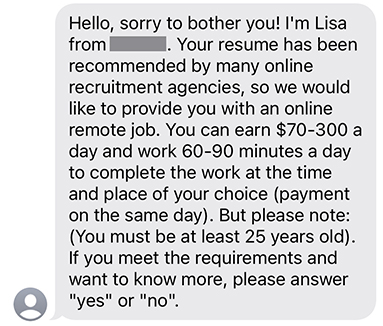
If you unexpectedly receive a job offer for an online remote job with an appealing commission or incentive for minimal hours, this is likely a money mule scam. Often you'll be contacted directly via text message or social media from someone claiming to be from a recruitment agency.
A legitimate company will not ask you to use your own bank account to transfer money on behalf of an organisation, open a new account to transfer money, or to register a company in your name. Your bank account is yours.
If you're approached by someone wanting to buy or rent your bank account, always reject the offer and don’t share your bank account details with anyone. Scammers can take over accounts to move money under a different name.
If you receive unexpected deposits in your bank account from someone you don’t recognise, contact us immediately. This could be a sign of money muling. The scammer might claim this to be an accident and offer you a portion of the money for the inconvenience if you send the rest of the money to a different account.
Scammers often create a sense of urgency to prevent you from thinking things through. If someone is pressuring you to transfer money quickly, this could be a scam.
Scams often rely on goodwill. Legitimate financial activity should always have a clear, lawful purpose that you fully understand. If you are not confident on how you’re helping someone by moving money you have received, contact us immediately.
Example of a money mule scam text message:
If you’ve shared any personal or banking details, change your passwords immediately and message us in the CommBank app or call 13 2221 or CommBiz 13 1998 and select option 4.
Get important scam information in your language by downloading our PDFs.
Ceba can help you lock your card or securely connect you to a specialist in the CommBank app.
Fast-track your call, see expected wait times and connect with a specialist in the CommBank app.
Send us a copy or screenshot if you receive a hoax email or SMS.